
Our lower-priced website launch required far more custom work than the larger project we launched the same week. For an agency, clear expectations can matter as much as the technology behind the build.
Meanwhile, our own WordPress sites were reaching performance scores in the high 90s after years of accumulated clutter. That made for a productive Friday, with two launches behind us and a mountain biking weekend ahead.
Fitness: getting back on the bike
After a work-heavy week, we were ready to finish packing the camper and head out for mountain biking, camping, and a birthday weekend with our son. The laptop was coming along for emergencies, but riding and family time were the priorities.

Some riding that challenged us on the Giant has become more enjoyable on the Signal Peak. We keep setting new personal records, which makes getting back out there even more appealing.
Two launches with very different expectations
Both client relationships began well. We met around the same time, completed needs assessments, prepared proposals, and agreed on statements of work. One project was more involved, so we priced it higher.
The difference emerged during delivery.
When “basic” means custom
The lower-priced project brought repeated requests for features the client considered basic. However, those requests required customizations that hadn’t appeared in the scope or onboarding discussions.
Eventually, the site contained roughly two dozen CSS and code customizations. One shopping-cart issue came from a customization conflicting with another.
We asked for specifics whenever a request was unclear, then generally turned changes around within 12 to 24 hours. After about a week, the work appeared buttoned up, although we weren’t confident the client felt satisfied.
When confidence carries through launch
The other client communicated delays, thanked the team, and expressed satisfaction with the work. When course and lesson featured images were missing, we created them and invited the client to review or replace them.
Most of that build used the products’ standard functionality. The client felt comfortable enough to launch, send users course vouchers, and leave for 10 days of mountain biking in Europe.
A minimum viable product needs room to stay minimal
The more difficult project began as a minimum viable product, with limited content and assets. The plan was to launch, generate revenue, and build further as the business grew. During delivery, expectations shifted.
For a startup without customers or sales, we favor using established tools as designed before reshaping them around imagined requirements. LifterLMS already provides a substantial foundation for courses and memberships.
The clients also had different approaches to serving customers. One wanted live sessions and help setting up events. The other wanted automation while keeping personal names, contact details, and photos off the website.
Those differences affect scope. They also put responsibility on us to improve scope-setting during website kickoff. Clients don’t always know how to express technical requirements.
We absorbed substantial unplanned work on the smaller project. We’re proud of our team’s response, but we also have to examine what we could have clarified sooner.
WordPress performance improved after removing clutter
Over roughly a month to six weeks, we tuned three of our own websites before taking the same approach further into client work. We wanted confidence that the improvements were stable.
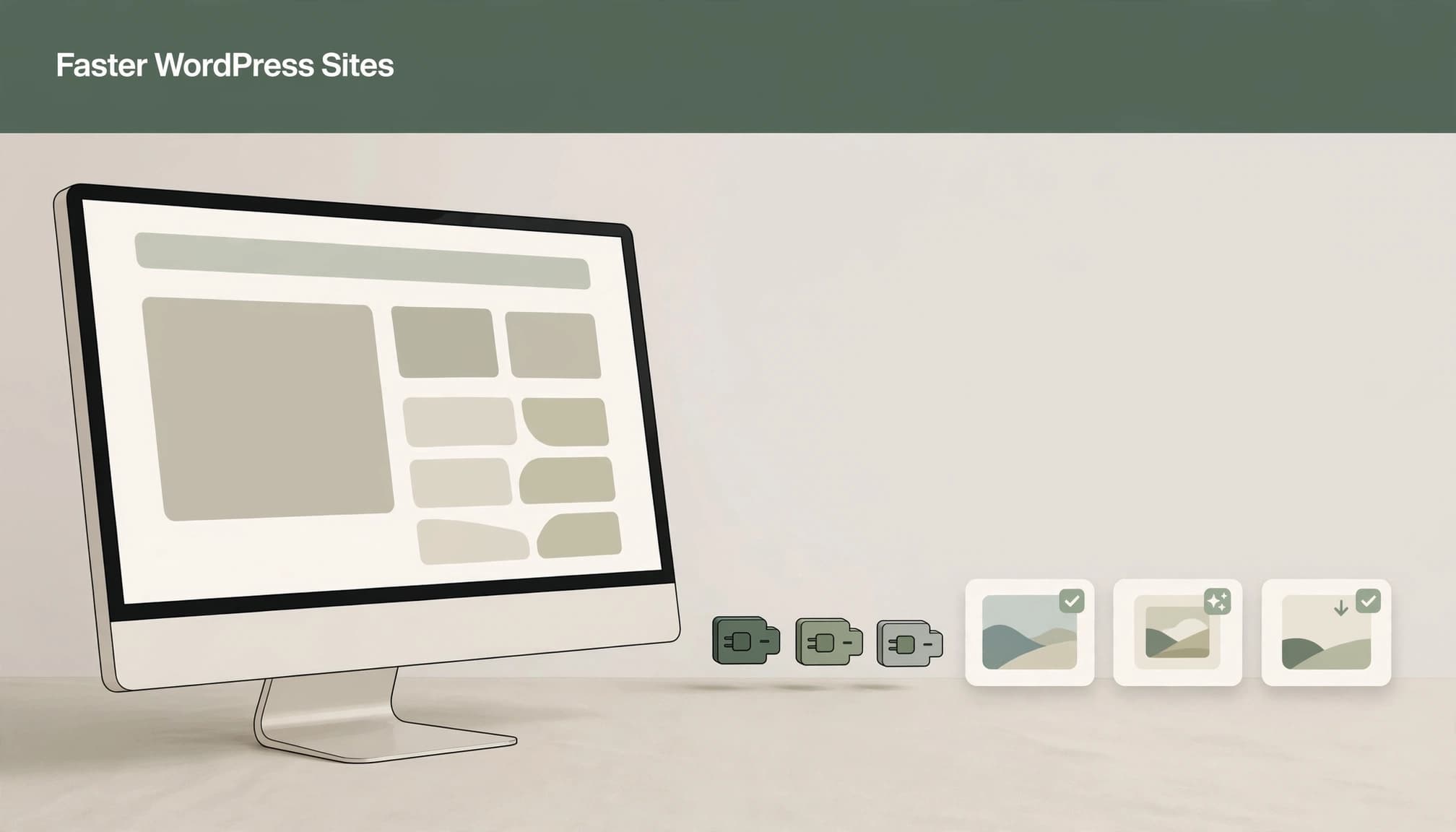
The work included image optimization, JavaScript adjustments, custom CSS, database cleanup, and removing unused plugins. One site still contained Groundhogg material and shortcodes after we’d switched to FluentCRM.
Those leftovers didn’t necessarily change what visitors saw. They still added unnecessary clutter.
The three tuned sites reached performance scores in the high 90s. That challenged our old assumption that an LMS, CRM, and multiple plugins automatically meant accepting a slow website.
A feature-rich site can perform well. The cleanup showed how much unnecessary material we’d allowed to accumulate around the tools we needed.
The results also made WordPress performance targets more relevant to our agency work. A client scoring in the 60s or 70s may need cleanup rather than a complete rebuild.
Four sites, different needs, similar cleanup opportunities
Speaking, eLearning, and leadership
Our redesigned Kurt von Ahnen website brings together speaking, coaching, training, courses, and podcast appearances. It runs LifterLMS, FluentCRM, and Fluent Forms while delivering the fastest browsing experience we’ve had on that site.
Meanwhile, our Manana No Mas! website doesn’t run an LMS. It focuses on our eLearning work, Power Sports Academy, and consulting in powersports and marine businesses. The redesign also states our WordPress focus more clearly: we build learning, community, and e-commerce platforms, then train teams to operate them.
Action Leadership Team promotes Action Leadership from the Edge and its companion courses. We moved it off Elementor and into Gutenberg with Astra. In our view, it looks cleaner as well as running faster.
We also incorporated the story behind our logo, the tilde and asterisk, into its design.
A course platform with a substantial toolset
PF University offers faith-based, college-level courses for college students and affluent families. Alongside its student catalog, it has separate course navigation for advisors, mentors, and ambassadors.
Image size was the main performance issue. After optimization and cleanup, the site reached the low-to-mid 90s despite running LifterLMS, payment tools, video embeds, and two CRMs, one for sales and one for marketing.
Freedom includes cooking and family time
By Friday afternoon, we were preparing to leave for the lake. That’s part of the freedom we value: choosing time for riding, barbecuing, and celebrating our son’s birthday.
The food preparation had already started overnight. We smoked a pork butt using charcoal and several woods, checking the fire every couple of hours.
Afterward, we pressure-cooked the meat for 90 minutes with ingredients including onions, garlic, and cilantro. Shredded and finished on a flat grill with peppers and Hatch green chilies, it was ready for tortillas.
Cooking at home belongs alongside exercise in our approach to fitness. Sleep matters too, even when an overnight smoke interrupts it.
Prepaid work protects the freedom to choose
Self-employment also means finding customers, maintaining relationships, invoicing, and collecting payment. You hear about the freedom, but those responsibilities remain.
Since 2008, we’ve required payment before starting work. Monthly clients pay for the coming month, not the one already completed.
If a corporation requires net-30 or net-60 terms, we can send the invoice and begin after payment arrives. We’d rather decline a project than chase money afterward.
Often, the delay sits with accounts payable or procurement rather than our client contact. We understand those systems because we’ve worked inside large organizations. We choose payment terms that keep us out of that cycle.
Finishing the week with room to step away
The contrast between these launches brought us back to expectations, reliable tools, and responsibility for our own process. Faster websites were another reminder that complexity deserves regular review.
For us, freedom requires boundaries around the work. Those boundaries help make room for the weekend we’d been looking forward to: bikes, family, and time away from the screen.